


Staff RN · Map My Pay Co-Founder · July 8, 2026
I have run this same exercise for nurses in California, Texas, New York, and Florida. Michigan kept landing in my inbox. Nurses here are watching the Corewell Health East contract fight, typing their city and "nurse salary" into a search bar, and getting a gross number with nothing behind it. So I pulled the Map My Pay data for eleven Michigan cities and five Midwest markets. What came back is not what most nurses expect.
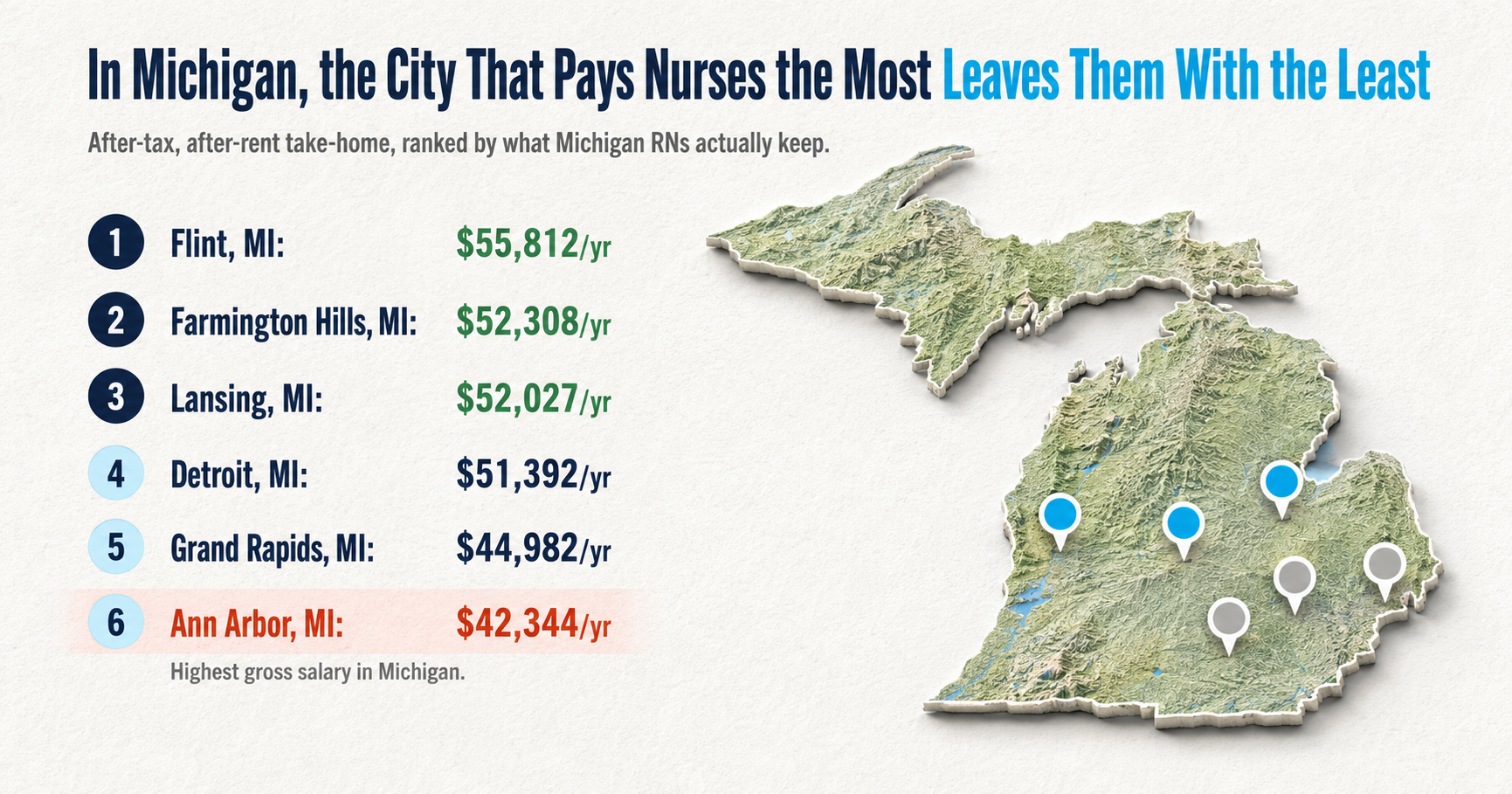
Ann Arbor has the highest median gross RN salary in the state at $97,030. It also lands dead last in Michigan on after-rent take-home. A Lansing nurse earning $7,390 less keeps $9,683 more per year once taxes and rent come out. That gap comes straight from rent. Ann Arbor averages $2,496 a month, and Lansing averages $1,282.
The gross ranking and the take-home ranking run in opposite directions in Michigan. That is the whole article.
Michigan gross RN salaries run from about $85,880 in Grand Rapids to $97,030 in Ann Arbor, an $11,150 spread. After-rent take-home runs from $42,344 in Ann Arbor to $55,812 in Flint, a $13,468 spread that flips the ranking on its head. Where you live inside Michigan decides your financial outcome more than which city posts the highest salary.
What Every Michigan Nurse Salary Page Gets Wrong
Michigan employs roughly 92,700 registered nurses, according to BLS data. The BLS OEWS May 2024 release puts the state median gross RN salary at $90,332, which sits below the national median of $93,600. That is the figure the salary aggregators publish, alongside city ranges for Detroit, Grand Rapids, and Ann Arbor.
None of them model the tax side. Michigan runs a flat 4.25% state income tax on top of federal brackets and FICA. For a nurse earning $90,000 to $97,000, that lands as an effective total tax rate of roughly 24.4% to 27.5% by city, with Detroit carrying an extra local income tax layer. After taxes, a Michigan nurse at the state median keeps about $68,000 to $71,000 before housing. Then rent comes out, and rent across the cities where Michigan nurses actually work varies by more than a factor of two.
This is not a Michigan quirk. When I ranked cities nationally, the same pattern showed up: smaller markets with low rent keep beating big-name metros on what nurses actually pocket. Michigan is that story in one state.
Map My Pay models after-tax, after-rent take-home for nurses in 785 Michigan cities. The gross salary on a job posting is where the math starts, not where it ends. Run your Michigan city on Map My Pay →
Best Cities for Nurses in Michigan, Ranked by What You Keep
Here are eleven Michigan cities ranked by what nurses keep after state and federal taxes plus average monthly rent. Every figure comes from Map My Pay's 2026 database using city-level effective tax rates and average rent.
| City | Gross Salary | Tax Rate | Avg. Rent/Mo | Monthly After Rent | Left Over/Year |
|---|---|---|---|---|---|
| Flint | $89,720 | 24.8% | $971 | $4,651 | $55,812 |
| Farmington Hills | $92,680 | 25.1% | $1,426 | $4,359 | $52,308 |
| Lansing | $89,640 | 24.8% | $1,282 | $4,336 | $52,027 |
| Kalamazoo | $89,450 | 24.8% | $1,287 | $4,320 | $51,841 |
| Detroit | $92,680 | 27.5% | $1,317 | $4,283 | $51,392 |
| Southfield | $92,680 | 25.1% | $1,517 | $4,268 | $51,216 |
| Dearborn | $92,680 | 25.1% | $1,758 | $4,027 | $48,324 |
| Troy | $90,580 | 24.9% | $1,875 | $3,794 | $45,532 |
| Royal Oak | $92,680 | 25.1% | $2,010 | $3,775 | $45,300 |
| Grand Rapids | $85,880 | 24.4% | $1,662 | $3,748 | $44,982 |
| Ann Arbor | $97,030 | 25.5% | $2,496 | $3,529 | $42,344 |
Ann Arbor tops every Michigan gross ranking and sits at the bottom of this one. The gross premium over Lansing is $7,390. The after-rent penalty runs the other way at $9,683 per year. The University of Michigan hospital market pulls Ann Arbor salaries up, and the same university-town economy pulls rents up faster.
Flint leads the state on after-rent take-home at $55,812 per year, and it does it on a gross salary that sits right in the middle of the pack. Average rent at $971 per month is the lowest of any Michigan city here and lower than most mid-sized Midwest cities. If you are optimizing for money kept rather than zip code prestige, the Flint math is hard to argue with.
I want to be honest about what that number does and does not tell you. Take-home is one axis, and working conditions are another. Right next to Flint, in Grand Blanc, more than 750 nurses and case managers at Henry Ford Genesys have been on strike since September 1, 2025, over nurse-to-patient ratios and a return-to-work agreement, making it one of the longest nurse walkouts in recent U.S. history. Henry Ford has offered raises of up to 13%, which would push the average nurse there toward $100,000, and the union still turned it down because the money did not fix the staffing and the seniority protections. A great leftover number and a floor you can stand on are two different things, and the smart move is to weigh both before you sign anywhere.
The Corewell Question: Same Contract, Different Take-Home by Campus
Nearly 10,000 Corewell Health East nurses, represented by Teamsters Local 2024, have been negotiating their first union contract since June 2025. Nurses voted about 90% in favor of a strike authorization in March 2026, held practice pickets in April and May, and returned to the table over the summer. As of early July 2026 they have reached more than twenty tentative agreements across staffing, wages, and benefits, with health insurance still the open sticking point and no strike date set. The nine campuses in this dispute sit across southeastern Michigan, in Royal Oak, Southfield, Dearborn, Farmington Hills, Grosse Pointe, Troy, Trenton, Wayne, and Livonia. Most coverage treats those nurses as one group. The take-home data says they are not.
Royal Oak and Detroit nurses in this database carry the same gross salary of $92,680. Same employer region, same metro, same tax bracket. Royal Oak average rent runs $2,010 per month, and Detroit runs $1,317. That gap alone is a $6,092 per year difference in take-home on identical pay. A Corewell nurse working the Royal Oak campus and renting nearby keeps $6,092 less than a nurse on a comparable contract who rents in Detroit.
Farmington Hills, at $1,426 in average rent, clears Royal Oak on take-home despite the same gross. When a contract standardizes wages across a multi-campus system, geography inside the same metro quietly decides the outcome. The contract sets your gross, but where you rent sets what you keep.
If you are deciding between campuses or neighborhoods, Map My Pay covers 785 Michigan cities with after-tax, after-rent take-home, so you can price out every commute option before you sign a lease. Compare Michigan cities on Map My Pay →
Michigan vs the Midwest: Detroit and Grand Rapids Against the Region
If you are weighing a move within the region, gross salary alone will steer you wrong. Here are Michigan's two largest nursing markets against four Midwest peers.
| City | State | Gross Salary | Tax Rate | Avg. Rent/Mo | Monthly After Rent | Left Over/Year |
|---|---|---|---|---|---|---|
| Minneapolis | MN | $102,790 | 28.1% | $1,638 | $4,518 | $54,220 |
| Indianapolis | IN | $89,290 | 23.7% | $1,356 | $4,318 | $51,818 |
| Detroit | MI | $92,680 | 27.5% | $1,317 | $4,283 | $51,392 |
| Milwaukee | WI | $91,040 | 25.6% | $1,398 | $4,246 | $50,950 |
| Columbus | OH | $89,170 | 25.2% | $1,414 | $4,142 | $49,708 |
| Chicago | IL | $96,480 | 26.1% | $2,292 | $3,646 | $43,753 |
| Grand Rapids | MI | $85,880 | 24.4% | $1,662 | $3,748 | $44,982 |
Detroit runs neck and neck with Indianapolis and Milwaukee, finishing within about $2,400 per year of both. Chicago earns $3,800 more gross than Detroit and leaves nurses with $7,639 less per year after taxes and rent. Chicago's $2,292 rent and Illinois's 26.1% effective tax rate erase the salary premium and then some.
Minneapolis leads the group at $54,220 per year and earns it. Minnesota's 28.1% effective tax rate is the highest here, but a $102,790 gross absorbs it while rent stays reasonable at $1,638. A Michigan nurse eyeing the Twin Cities is looking at roughly $2,800 more per year in take-home on $10,110 more gross. Whether that clears the cost of relocating is a personal call, but the numbers are real. If you want that math across every state, I ranked all fifty states by after-tax, after-rent leftover income here, and the same take-home logic that decides a first job decides a mid-career move.
Grand Rapids lands below Chicago on take-home while paying $10,600 less gross. Below-average pay plus moderate rent produces a result that trails every other Midwest city here. If you are in Grand Rapids and take-home is your priority, you have a real case for chasing contracts elsewhere, and the high-gross-city problem I broke down for San Diego and Miami Beach shows up in the Midwest too.
Two Michigan contract fights are live as of July 2026. Corewell Health East and Teamsters Local 2024 are still without a first contract for nearly 10,000 nurses, with health insurance the last major open issue and no strike date called. Near Flint, the Henry Ford Genesys strike has run since Labor Day 2025 with no settlement. If either lands, read past the headline raise. The after-rent take-home by campus, not the gross number, is what those terms actually deliver.
What This Means for Your Next Michigan Move
Here is how I would use this if I were job hunting in Michigan tomorrow. The gross ranking puts Ann Arbor first and Flint in the middle. The take-home ranking puts Flint first and Ann Arbor last. When a recruiter quotes you a number, that number is a starting bid, not your paycheck. Michigan's flat 4.25% tax and your rent turn it into something else entirely, and a $5,000 raise at a nurse's income nets closer to $3,300 once federal, state, and FICA take their cut.
So price the city, not the salary. Line up the campus you would work against the zip code you would rent in, because on a standardized contract that choice can swing your take-home by thousands with the offer letter untouched. The gross number is the loudest part of any nursing job, and it is the least honest about what you keep. Run yours before you sign the lease.
Map My Pay models after-tax, after-rent take-home for 785 Michigan cities and every major Midwest market. Before you take an offer, sign a lease, or weigh a contract, see what you actually keep.
Run your Michigan city on Map My Pay →Full Sources: Bureau of Labor Statistics, Occupational Employment and Wage Statistics (OEWS), registered nurse median salary by state and metro, May 2024 release; Map My Pay, DevExport City Database (785 Michigan cities plus Midwest markets, 2026); ZipRecruiter and Glassdoor, Michigan registered nurse salary data (2026); Detroit News and FOX 2 Detroit, Corewell Health East and Teamsters Local 2024 negotiation coverage (2026); Spectrum News, ABC12, and Michigan Public, Henry Ford Genesys and Teamsters Local 332 strike coverage (2026); Michigan Department of Treasury, 2026 individual income tax rate (4.25% flat); City of Detroit income tax ordinance (2.4% resident and 1.2% non-resident, 2026).